Read the full article by Glyn Hutchinson on Yachting Pages
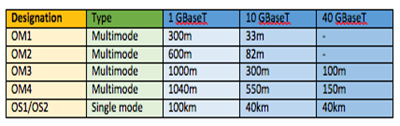 So why don’t we just switch to Fibre Optics for all our data needs today and be done with it?
The answer lies in the cost of hardware and installation. Whilst Fibre Optic cable is not significantly more expensive than the higher spec copper (Cat7/8) cable, the terminations, tools and time required to terminate add to the installation cost. Furthermore the electronic (SFP) transceiver modules at each end (essentially each socket includes a laser to transmit/receive the signal) result in a large increase in cost for Fibre Optic hardware.
Therefore the answer to which cable you should choose lies in the following criteria:
So why don’t we just switch to Fibre Optics for all our data needs today and be done with it?
The answer lies in the cost of hardware and installation. Whilst Fibre Optic cable is not significantly more expensive than the higher spec copper (Cat7/8) cable, the terminations, tools and time required to terminate add to the installation cost. Furthermore the electronic (SFP) transceiver modules at each end (essentially each socket includes a laser to transmit/receive the signal) result in a large increase in cost for Fibre Optic hardware.
Therefore the answer to which cable you should choose lies in the following criteria:
What you need is Cat 8 as it is the latest and greatest… right?
Not necessarily. Anyone who has been involved in a technology project faces the same quandary and in this digital age the cable for most applications is a data cable. Simply put, this is called Ethernet. Most people understand what an Ethernet cable looks like, but who understands the difference between the various flavours? Lets break this down into some simple facts: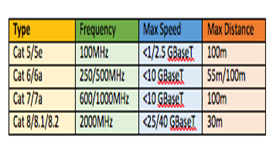 The prefix ‘Cat’ stands for Category and doesn’t specify the type of cable, but the performance criteria that must be met. Performance is defined by Frequency, Max Transmission Speed and Max Distance and even includes installation criteria such as minimum bend radius and what cable ties to use.
- The Cat number has increased with each new generation of cable since the early 1990’s (Cat 3 was old telephone cable, FYI).
- Cat xxx is usually followed by UTP, FTP, STP, S/FTP, which tells you more about the physical characteristics of the cable than the Cat number.
- UTP – Unshielded Twisted Pair
- FTP – Foiled Twisted Pair
- STP – Screened Twisted Pair
- S/FTP – Screened Foiled Twisted Pair
So why don’t we just switch to Fibre Optics for all our data needs today and be done with it?
The answer lies in the cost of hardware and installation. Whilst Fibre Optic cable is not significantly more expensive than the higher spec copper (Cat7/8) cable, the terminations, tools and time required to terminate add to the installation cost. Furthermore the electronic (SFP) transceiver modules at each end (essentially each socket includes a laser to transmit/receive the signal) result in a large increase in cost for Fibre Optic hardware.
Therefore the answer to which cable you should choose lies in the following criteria:
- Application – Does this link need high-speed capability – now or in the future?
- Distance – How long is the cable run?
- Budget – What are the budget limitations and is there a lower-cost cable that is fit for purpose?